
Leading anti-money laundering, identity theft protection and payment card companies track these activities in the dark web to prevent fraud and protect brands, financial assets, accounts and investments from cyber criminals. ICQ and Telegram are very common among financial fraud actors, and we witness leaked credit cards and credit card information for sale posted on these platforms on a daily basis. A common method for criminals on the dark web who abuse legal services and sites for fraud activity.For example, SmartMixer or Dark Wallet are cryptocurrency mixing sites that can be manipulated for money laundering. We see financial data entities sold on various different sources daily, which proves just how easy it is for criminals to carry out financial fraud.
Illegal Activities And Marketplaces
The dark web is a part of the deep web that contains websites not included in the mainstream search engine index. For these reasons, it’s a good idea to safeguard your online activities with NordVPN while using the dark web. This platform’s library of websites currently totals 50, which may not sound impressive until you consider that all the links are active and popular. If we need a website to get links to other hidden sites, we will choose Hidden Wiki. As the name suggests, this is a dark web alternative to the regular Wikipedia, which contains links to various websites found on the dark web.
Using OSINT And Dark Web Data To Safeguard Financial Services
Today’s cybercriminals spread their activities across multiple platforms, making them harder to track and shut down. Despite growing crackdowns from law enforcement agencies, the dark web remains a hotbed of criminal activity, offering everything from drugs to stolen data. Some of these factors include technological advancement, government regulation, public pressure, economic incentives, and criminal innovation. These technologies may provide new opportunities for privacy and security or open new avenues for criminal exploitation and government surveillance. Therefore, it is essential to monitor and analyze emerging technologies and their potential impact on the Dark Web, such as blockchain, artificial intelligence, and quantum computing. While the Dark Web offers anonymity and freedom from regulation, it is not immune to law enforcement surveillance or intervention.
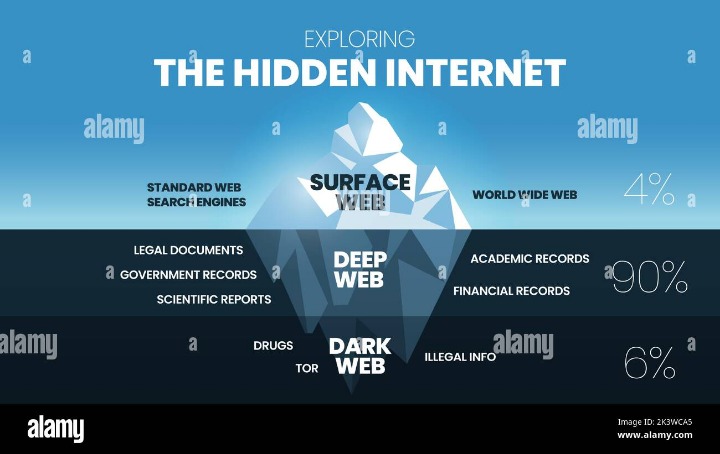
The deep web is the hidden and invisible part of the internet that you can’t find online normally. Deep web and the dark web, however, aren’t accessible through search engines like Google, Bing, DuckDuckGo, etc. Surface web is a part that you can access through a normal browser and search engines. These tools, designed for legitimate purposes, serve functions such as protecting user IP addresses and providing a proxy network for journalists reporting from precarious territories. While both spaces can host both legal and illicit activities, the Deep Web typically serves as a haven for legitimate endeavors, contrasting sharply with the Dark Web's notoriety for fostering illegal activities. The integration of web content into the Surface Web involves the deployment of web crawlers by search engines like Google, Yahoo, and Bing.
- The Deep Web, primarily concealed to safeguard lawful content, constitutes a realm intentionally kept invisible from unauthorized access.
- Already a household name in the VPN market, its developers keep upgrading it with new features to keep it ahead of its competitors.
- The financial services sector faces a relentless wave of cyber threats, fraud schemes and insider risks – many of which first surface in OSINT sources or dark web forums.
- It serves legitimate purposes such as data security, privacy, and access to subscription-based content.
Data Sheets
Researchers Daniel Moore and Thomas Rid of King’s College in London classified the contents of 2,723 live dark web sites over a five-week period in 2015 and found that 57% host illicit material. The dark web is a part of the internet that isn’t indexed by search engines. On those websites, the technology provides anonymity and obfuscation. Even the term “dark web” is foreboding, as it may evoke images of a sinister, inaccessible digital back alley where hackers openly sell stolen data; drugs and terrorism proliferate; and anonymity reigns.

These networks use complex encryption algorithms to hide the identity and location of users, making it difficult for law enforcement to track their activities. However, there is another side of the internet that is hidden, inaccessible through traditional means, and commonly known as the Dark Web. Google and Bing might lead us to a front door a search interface, but it generally can't search the content of a database. These pages are indexed crawled by web crawlers that are used to build the databases of search engines such as Google and Bing. And there are many phishing websites on the dark web that may collect your data and use it for something else.

Our Websites
The dark web is a small subset of the deep web comprising purely non-indexed websites and services. It comprises websites that aren’t easily accessible mainly because they are non-indexed, password-protected or paywalled. The open web (also known as the surface web) is the part of the internet that’s easily accessible to all users.
Begin With A Threat Model, Not A Download
Although it plays a key role in protecting private data and supporting business operations, teams must monitor it actively. All these use cases depend on restricted access and robust data protection. And thirdly, threat actors often target Deep Web environments to disrupt operations or extort data. Firstly, data breaches can occur when hackers infiltrate protected networks to steal sensitive information. Most people are familiar with search engines like Google or Bing.
Moreover, NordVPN is a service that doesn’t store or log your search results. A virtual private network (VPN) is a good way to mask Tor activities. Since you are navigating in uncharted territories with all the myriad threats today, you’ll have to disable them in your network settings to stay safe. This dark web monitoring will help you track illicit activities and minimize the risks of cyber-attacks.
Search Engines (not To Expect Much)
Perhaps the most surprising category is full-service banking services that operate on the deep web. They work by mixing the cryptocurrencies of multiple users before redistributing them, breaking the audio trail left by transactions on public blockchains. Tumblers or mixers are services designed to make cryptocurrency transactions difficult to trace. With no regulation or legal recourse mechanisms, it is common for these services to disappear with user funds (in an exit scam) or to be frequently hacked. These markets allow transactions with high levels of anonymity, without KYC (Know Your Customer) or AML (Anti-Money Laundering) processes. Cryptocurrency exchanges on the deep web operate outside the regulatory frameworks that apply to mainstream platforms like Coinbase or Binance.
In addition, attacks on other sectors can also impact the financial industry. With the increase in risks comes an increase in the need to hold regulatory capital in reserve, reducing the capital otherwise available for use and ultimately hurting the financial sector. The higher the risk, the more capital the financial sector must set aside to manage it.
Although Tor provides a stable and secure connection, users should be aware of possible leaks or vulnerabilities that may compromise their anonymity. The most popular way to access the Dark Web is by using the Tor Browser, which is a modified version of the Firefox browser that routes traffic through the Tor network. In recent years, several high-profile Dark Web marketplaces, such as Silk Road and AlphaBay, have been shut down by law enforcement, leading to the arrest and prosecution of their operators and users.

Furthermore, data will help to detect attacks against the network and possible censorship events. The goal of an anonymous and privacy network, Tor, is not to engage in the extensive collection of data. Its goal is to offer anonymous access to the content without being censored, no matter where you live. The BBC news website has a special .onion site, which you need to access via the dark web. Facebook’s dark web version allows users to access the site where it is banned or restricted. It does not share IP addresses or web search history to protect your privacy.
Malicious threat actors also sell login credentials to banking app accounts with funds in them. These malicious software are designed to infiltrate banking systems, siphon off funds, or lockout legitimate users until a ransom is paid. Sophisticated threat actors may also offer “Banking Trojans” or “Ransomware-as-a-Service” on the dark web, allowing cybercriminals of various skill levels to launch potent attacks. → Read our report Government Agency Targeted to learn about how we helped an organization spot and stop a threat actor before the cyberattack could be executed. Often this comes down to explaining the value of collecting data from the dark web to senior stakeholders.
NordVPN allows you to create your private encrypted network for safe file sharing and work using its Meshnet feature. Conventionally, Nord also doesn’t log your data and uses AES 256 encryption. Already a household name in the VPN market, its developers keep upgrading it with new features to keep it ahead of its competitors. It is one of the most reliable options for streaming or downloading content. Virtual Private Networks (VPNs) keep you safe when surfing the internet in various ways. When you activate the software, it actively scans any files your device saves from the internet before they get saved onto your phone.
Search the web for lists of .onion sites and you'll find some places to start. You're losing the anonymity you normally have when you connect to a .onion site through the Tor browser. While using the Tor browser, you can click links to .onion addresses and they'll load normally. It's a modified version of Firefox that's configured to connect to sites through the Tor network. To access a .onion address, you'll need to access it through the Tor Browser.
After all, some websites on the deep web are like those on the open internet, except that they are hidden behind a paywall or protected via passwords to limit access. Some content and services on the deep web are indexed by search engines, but paywalls or password protection prevent access. It's a place where you'll find data leaks and illegal trades, but also legitimate, legal online activities users want to carry out without attracting the attention of law enforcement agencies or governments. The darknet, also known as the dark web, is a hidden part of the internet that cannot be accessed via normal search engines such as Google or Bing…. An even darker and more hidden level is the mega-darknet, which is only accessible to a few users and where even more anonymity and security are offered. It includes valuable databases from governments, universities, hospitals and companies that require secure and controlled access.The deep web consists of all parts of the internet that cannot be indexed by conventional search engines.
Remember that illegal activities can still incriminate you, whether you are using a Tor browser. People in countries with heavy internet censorship must get a VPN or Tor browser to access the surface web. It is a good way to prevent third parties from tracking online activities. The creators assert that because their technique is so strong, even malware with root access could not determine the machine’s IP address.